What Are Robot Bearings?
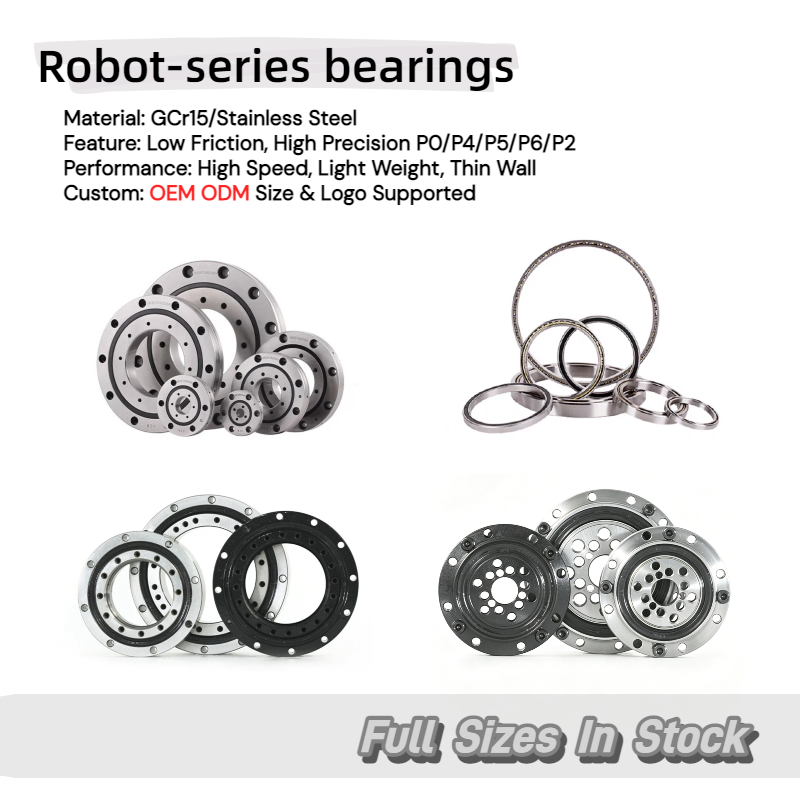
Robot bearings are compact, high-rigidity, zero-backlash precision bearings designed exclusively for robotic automation. Unlike ordinary bearings that only bear single radial or axial loads, professional robotic bearings handle radial load, axial load, and heavy overturning moment simultaneously.
Featuring ultra-thin cross-sections, low friction torque, and minimal elastic deformation, they solve traditional bearing pain points such as bulky size, low rigidity, and operational vibration, ideal for modern lightweight, high-precision robotic arms.
Different robot applications require matched industrial robot bearings. The four mainstream types are listed below:
1. Crossed Roller Bearings (Core Type)
Crossed roller bearings are the standard solution for robot joints and harmonic reducers. With 90° alternately arranged cylindrical rollers, one single bearing replaces multiple traditional units, delivering ultra-high rigidity and a compact structure.
Common series: RB, RU, RA, CRB, SHF/SHFG, suitable for 6-axis industrial robots and collaborative robot joints.
2. Thin Section Slim Bearings
Ultra-thin, lightweight equal-section bearings for robot end-effectors and wrist parts, supporting robot miniaturization and lightweight design.
3. Four-Point Contact Ball Bearings
Capable of bidirectional radial and axial loads, widely used for large robot turntables and rotary base structures.
4. Angular Contact Ball Bearings
Low-noise and high-speed resistant, mainly applied in robot auxiliary high-speed transmission parts.
Key Advantages of Precision Robot Bearings
High-quality precision robot bearings outperform standard bearings with core strengths:
Multi-directional Load Capacity: Supports radial, axial and overturning moment loads to simplify robot mechanical structure
Zero Backlash & High Precision: Adjustable preload eliminates clearance, P2/P4/P5 precision for micron-level positioning accuracy
High Rigidity & Stability: Roller line contact structure suppresses vibration and jitter during robot movement
Compact & Lightweight: Ultra-thin cross-section saves space and reduces robot overall weight
Low Friction & Long Lifespan: Optimized structure reduces wear, supporting long-cycle continuous operation
Easy Installation: Pre-reserved mounting holes and split/integral structures lower assembly errors
Typical Applications
Robotic bearings are widely used in high-end automation industries:
Industrial Robots: 6-axis arm joints, rotary bases, harmonic reducer components
Collaborative Robots: Lightweight flexible joints and end rotating parts
Semiconductor Robots: P2/P4 ultra-precision bearings for wafer handling and precision positioning
Medical Robots: Low-noise, high-stability bearings for surgical and inspection robots
Automation Equipment: Precision rotary tables and automated manipulators
Robot Bearing Selection Guide
Improper bearing selection causes robot jitter, positioning deviation and short service life. Follow these core rules to choose high-quality robot bearings:
1. Match Application & Load
Choose crossed roller bearings for joints/reducers, slim bearings for lightweight ends, and four-point contact bearings for large turntables.
2. Select Appropriate Precision Grade
P5 for standard industrial robots; P4/P2 ultra-high precision for semiconductor and medical robotic equipment.
3. Adapt to Working Environment
Use 2RS/2Z sealed bearings for dusty/oily conditions and stainless steel bearings for humid or corrosive environments.
4. Prioritize Zero-Backlash Rigid Design
High-precision robots require zero or negative clearance preloaded bearings to avoid rotation backlash.
5. Standard & Custom Sizes
Adopt RB/RU/RA/SHF standard series for regular use; support OEM/ODM customization for special dimensions and performance requirements.
Robot Bearing Maintenance Tips
Proper maintenance prolongs the service life and retains the precision of robot bearings:
Supplement professional precision grease regularly to avoid dry friction and abnormal noise
Block dust, moisture and impurities to prevent raceway wear
Avoid long-term overload operation to prevent permanent component deformation
Regularly inspect preload and clearance to sustain positioning accuracy
FAQs
Q1: Why use crossed roller bearings for robot joints?
A1: Crossed roller bearings offer multi-load capacity, zero backlash, high rigidity and compact size, perfectly matching robot joint miniaturization and high-precision requirements, irreplaceable by ordinary ball bearings.
Q2: What precision grade is suitable for robot bearings?
A2: P5 grade for conventional industrial robots; P4/P2 ultra-high precision for medical and semiconductor precision robots.
Q3: Can robot bearings be customized?
A3: Yes. We provide full OEM/ODM customization for special sizes, seals, materials and preload parameters.
Conclusion
Crossed roller robot bearings are the core of high-performance robotic equipment, featuring high rigidity, zero backlash, compact structure and multi-load resistance. Correct selection, standard installation and regular maintenance ensure stable robot operation and long service life.
We supply full-series standard and custom robot bearings, providing professional model selection and technical support for robotic automation projects.


 +86-18615202650